Research · 82 rulings using a published fee schedule
USAO, Fitzpatrick and Laffey Matrix Rates vs. What Courts Approve (2026)
In this article
What are fee matrices and schedules?
Published tables of hourly rates by experience that some courts use instead of case-by-case market evidence.
A few federal courts set rates from a published schedule instead of case-by-case market evidence. Lawyers search these every year, and the rulings show how closely courts follow them.
D. Maryland: what courts approve
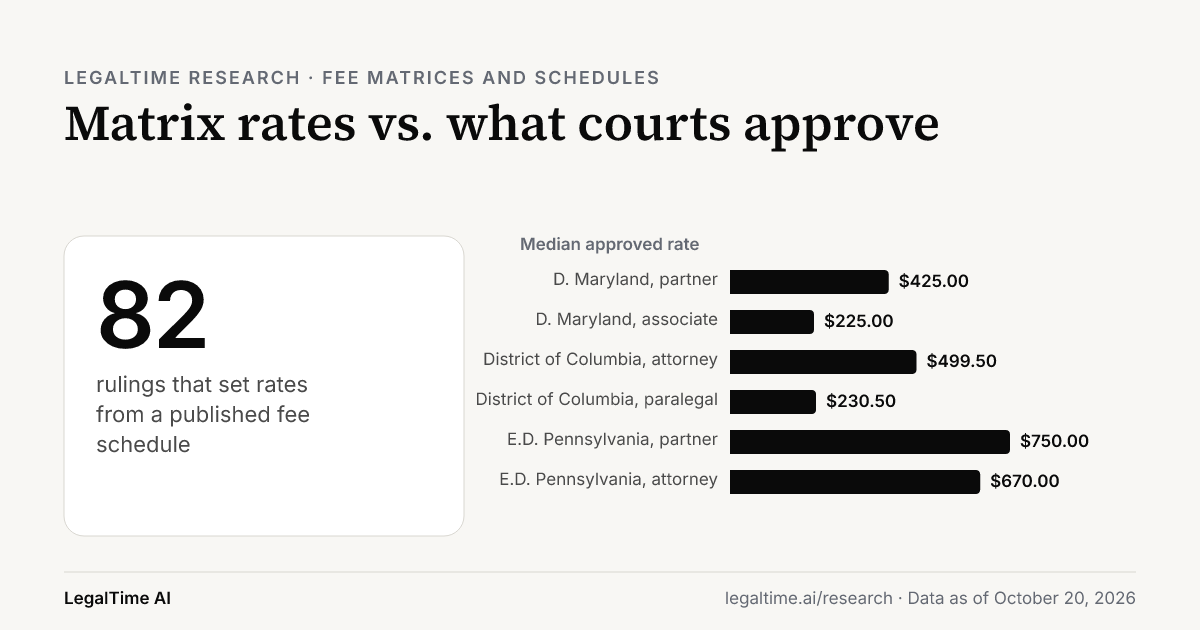
57 rulings since January 2024: partners $425, associates $225, attorneys $350, paralegals $150.
The District of Maryland publishes guideline hourly rate ranges by years of experience in Appendix B to its Local Rules. Judges treat them as presumptively reasonable.
| Role | Median approved | Middle half | Rates |
|---|---|---|---|
| Partner | $425 | $350 to $475 | 17 |
| Associate | $225 | $225 to $275 | 11 |
| Attorney | $350 | $285 to $465 | 73 |
| Paralegal | $150 | $150 to $210 | 32 |
$695.00 for Omar Vincent Melehy (Partner) (Guillen Serrano v. Maki, LLC, Sep 2, 2026)
Mr. Melehy has been practicing law for more than 38 years and charges an hourly rate in the amount of $750.00 per hour. (Ramirez v. Sterling Auto Service and Body Shop, LLC et al, Aug 25, 2026)
All approved rates in the D. Maryland
District of Columbia: what courts approve
15 rulings since January 2024: attorneys $500, paralegals $231.
The District of Columbia uses fee matrices: the Laffey matrix, its LSI-adjusted version, and the matrix published by the U.S. Attorney's Office (now based on the Fitzpatrick Matrix). Courts often accept the USAO matrix as evidence of prevailing rates for complex federal litigation.
| Role | Median approved | Middle half | Rates |
|---|---|---|---|
| Attorney | $500 | $375 to $682 | 38 |
| Paralegal | $231 | 6 |
the Plaintiff seeks attorney fees for "three (3) hours of [her] attorney's time" on the trial date of May 18, 2026, "at the hourly rate . . . of $375," for a total of $1,125.00. (EZEKWESILI v. PROCTOR et al, Oct 1, 2026)
Hilado proposes an hourly rate of $745 for Stephen Swift and $675 for Charity Swift, which are lower than those in the rate table. (HILADO v. MEDSTAR GEORGETOWN MEDICAL CENTER, INC., Mar 5, 2026)
All approved rates in the District of Columbia
E.D. Pennsylvania: what courts approve
10 rulings since January 2024: partners $750, attorneys $670.
In the Eastern District of Pennsylvania, courts often look to the fee schedule published by Community Legal Services of Philadelphia as evidence of market rates.
| Role | Median approved | Middle half | Rates |
|---|---|---|---|
| Partner | $750 | 7 | |
| Attorney | $670 | $489 to $830 | 10 |
The requested rate of $685 for Mr. Berney, who has over twenty-five years of experience, falls well below the CLS rate of $735-850 for attorneys with his degree of experience. (C. v. COLONIAL SCHOOL DISTRICT, Feb 5, 2026)
Plaintiff's counsel billed at the rate of $375.00 per hour, which is within the CLS fee schedule for an attorney of her experience. She expended around 28.7 hours in this litigation. (OLIVER v. WHEELS AMERICA PENNSYLVANIA, LLC, Dec 16, 2025)
All approved rates in the E.D. Pennsylvania
Do courts cut matrix rates?
Rarely. D. Maryland: 5.2% of requested rates cut; District of Columbia: 5.5% of requested rates cut; E.D. Pennsylvania: 17.4% of requested rates cut.
Using a schedule moves the fight from the rate to the hours, so records matter more, not less. See what a fee declaration needs and which objections courts accept.
Methodology and sources
- Federal rulings on GovInfo since January 2024 in which the court set rates from a published schedule or matrix, identified from the opinion (82 rulings in courts with at least 5).
- Approved rates are checked against the opinion text. Matrix rates differ by experience band, so medians mix bands; see each court's rulings for the band.
Limitations. This page reports what courts approved, not the official matrix tables; consult the published schedules for current figures. Some federal districts publish few or no opinions to GovInfo, including the Southern District of New York, the Northern District of Illinois, the Middle District of Florida, the Eastern District of Virginia, the Western District of Washington and the District of Nevada. They are missing or thin here. LegalTime sells timekeeping software for law firms. The sections on LegalTime describe our own product; everything else comes from the court rulings.
General information from public court rulings, not legal advice. Data: CSV (CC BY 4.0). Spot an error? Email team@legaltime.ai with the case name and we will correct it.
FAQ
What is the Laffey matrix?
A table of hourly rates by years of experience, first developed in the D.C. litigation Laffey v. Northwest Airlines and used since as evidence of prevailing rates in Washington, D.C. Updated versions include the LSI-adjusted Laffey matrix and the USAO matrix.
What is the USAO or Fitzpatrick matrix?
The rate matrix published by the U.S. Attorney's Office for the District of Columbia, now based on the Fitzpatrick Matrix. D.C. courts often accept it as evidence of reasonable rates for complex federal litigation.
What rates do D.C. federal courts approve under the matrices?
In 15 rulings since January 2024: attorneys $500, paralegals $231. The requested rate was cut for 5.5% of timekeepers.
What are the District of Maryland Appendix B rates?
The District of Maryland publishes guideline hourly rate ranges by years of experience in Appendix B to its Local Rules. Judges treat them as presumptively reasonable. In 57 rulings since January 2024, approved medians were: partners $425, associates $225, attorneys $350, paralegals $150.
Does the Laffey matrix apply outside D.C.?
Generally no. Courts outside D.C. set rates from the local market, though some accept a matrix adjusted for local costs. Check what courts in your district approve.