Research · Fee petitions
Declaration in Support of Attorney Fees: What Courts Require (2026 Checklist and Template)
In this article
What is a declaration in support of attorney fees?
The sworn evidence behind a fee motion: who worked, at what rate, for how many hours.
A declaration (or affidavit) in support of a fee motion is the evidence for both halves of the lodestar: who worked, at what rate, and for how many hours. Most cuts in the data trace back to something missing from it.
What should it include?
- Identify every timekeeper. Name, role, bar admission year and experience for each lawyer and paralegal. Courts cut or deny time for timekeepers they cannot identify.
- Attach contemporaneous time records. Records made when the work was done, not rebuilt later. Missing or reconstructed records draw cuts, and some circuits require contemporaneous records outright. Courts cut for this in 2.9% of rulings with a cut, median 25%.
- One task per entry. Block-billed entries draw percentage cuts because the court cannot tell how long each task took. Courts cut for this in 12.2% of rulings with a cut, median 20%.
- Describe each task specifically. Say what was done, on which document or issue, and why. Entries like "attention to file" or "research" are cut as vague. Courts cut for this in 13.9% of rulings with a cut, median 25%.
- Leave out clerical work. Filing, scheduling and copying are overhead. Courts strike them when billed at professional rates. Courts cut for this in 21.4% of rulings with a cut, median 25%.
- Show billing judgment. State the hours you wrote off (duplicative, unproductive, unrelated). Courts cut further when the request shows no reductions. Courts cut for this in 29.4% of rulings with a cut, median 25%.
- Support the rate with outside evidence. Prior awards in the district for comparable lawyers, declarations from other practitioners, and fee surveys. Your own say-so is not enough. Courts cut for this in 38.2% of rulings with a cut, median 23%.
- Separate unrelated or unsuccessful claims. Segregate time on claims that failed or were not fee-eligible, or explain why the work was intertwined. Courts cut for this in 19.6% of rulings with a cut, median 36.7%.
- State the travel time policy. Many courts pay travel at half rate. Bill it that way or explain why not. Courts cut for this in 4.7% of rulings with a cut, median 50%.
- Include time on the fee motion itself. Fees on fees are usually recoverable but are cut when they look out of proportion. Courts cut for this in 7.7% of rulings with a cut, median 30%.
What gets cut when it is missing?
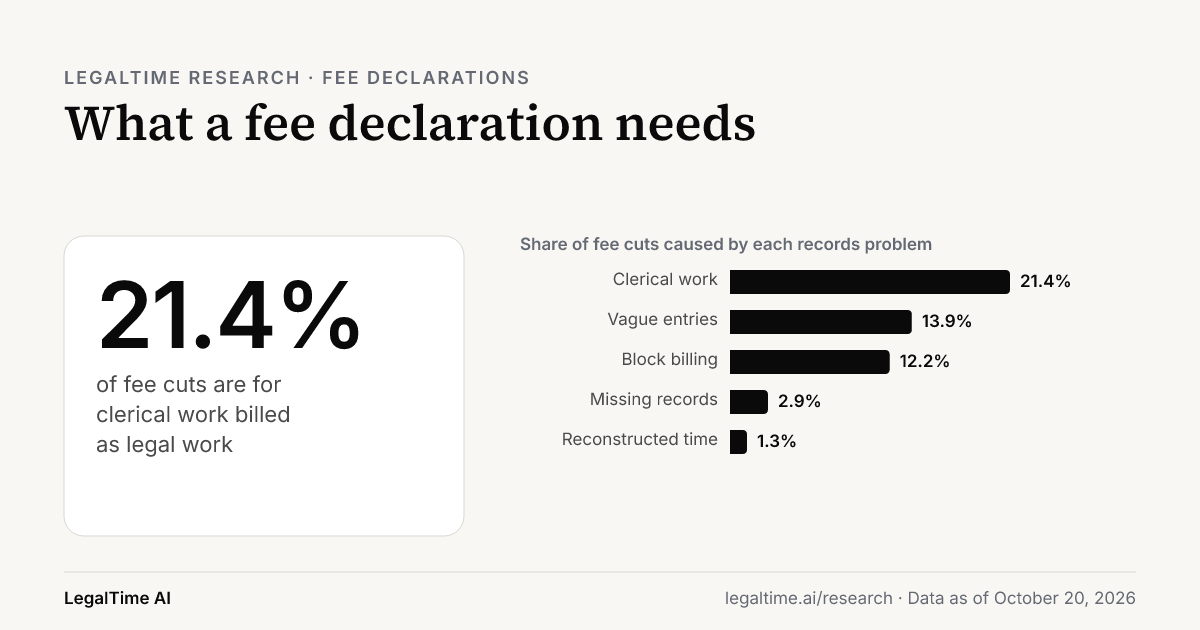
The time-record problems below appear in 21.4% or fewer of cuts each, but together they are the cuts a firm controls completely.
| Problem | Share of rulings with a cut | Median reduction stated |
|---|---|---|
| Clerical work billed as legal work | 21.4% | 25% |
| Vague entries | 13.9% | 25% |
| Block billing | 12.2% | 20% |
| Missing contemporaneous records | 2.9% | 25% |
| Reconstructed time | 1.3% |
Declaration template
A starting structure. Adapt it to your court's local rules and the fee statute; this is not legal advice.
DECLARATION OF [NAME] IN SUPPORT OF MOTION FOR ATTORNEY FEES

I, [Name], declare:

1. I am [position] at [firm], counsel for [party]. I have personal knowledge of the facts stated here.

2. Timekeepers. The following people worked on this matter:
   [Name], [role], admitted [year], [years] years of experience in [practice area]. Requested rate: $[rate].
   [Repeat for each lawyer and paralegal.]

3. Time records. Attached as Exhibit A are our time records for this matter. Each entry was recorded at or near the time the work was done and shows the date, the timekeeper, the time spent in tenths of an hour, and a description of the specific task.

4. Billing judgment. Before submitting these records I reviewed every entry and removed [number] hours ([amount]) for [duplicative, unproductive, clerical or unrelated] work, listed in Exhibit B.

5. Unrelated claims. [Explain how time on unsuccessful or non-fee-eligible claims was separated, or why the claims were intertwined.]

6. Reasonable rates. The requested rates are within the prevailing market rates in this district for lawyers of comparable skill and experience, as shown by [prior awards in this district, attached declarations of other practitioners, fee surveys] (Exhibit C).

7. Travel. Travel time is billed at [half rate / not billed].

8. The total lodestar requested is [hours] hours, $[amount].

I declare under penalty of perjury that the foregoing is true and correct.

Executed on [date] at [city, state].

[Signature]
Keeping records that hold up
Every item above depends on time records made as the work happens: one entry per task, a timestamp, and a description of what was done. That is what LegalTime records automatically. See also fee cuts for bad time records and court-approved rates by district for the rate evidence.
Methodology and sources
- Reduction shares come from every federal ruling on GovInfo since January 2024 that decided a fee amount and cut it (2,076 rulings).
- The checklist reflects the reductions courts made and the standards in Hensley v. Eckerhart, 461 U.S. 424 (1983) and Blum v. Stenson, 465 U.S. 886 (1984).
Limitations. Some federal districts publish few or no opinions to GovInfo, including the Southern District of New York, the Northern District of Illinois, the Middle District of Florida, the Eastern District of Virginia, the Western District of Washington and the District of Nevada. They are missing or thin here. LegalTime sells timekeeping software for law firms. The sections on LegalTime describe our own product; everything else comes from the court rulings.
General information from public court rulings, not legal advice. Data: CSV (CC BY 4.0). Spot an error? Email team@legaltime.ai with the case name and we will correct it.
FAQ
What goes in a declaration in support of attorney fees?
Who worked on the case and their qualifications, the rate requested for each and the evidence that it is the market rate, contemporaneous time records with specific task descriptions, the hours written off in billing judgment, and how time on unrelated claims was separated.
Do I need contemporaneous time records for a fee motion?
Courts expect records made at the time of the work, and some circuits require them. Since January 2024, courts cut fees for missing or reconstructed records in 4.2% of rulings with a cut, with a median stated reduction of 25%.
Is an affidavit the same as a declaration for attorney fees?
They serve the same purpose. Federal courts accept an unsworn declaration under penalty of perjury (28 U.S.C. § 1746) in place of a notarized affidavit.
How do I prove my hourly rate is reasonable?
With evidence beyond your own statement: prior awards in the same district for lawyers of similar experience, declarations from other practitioners, and fee surveys.