Research · 2,076 federal rulings that cut a fee
Objecting to a Fee Petition: Which Objections Courts Accept (2026 Data)
In this article
How often do courts cut a fee request?
Federal courts cut the requested fee in 53.8% of 3,862 rulings since January 2024 that decided a fee amount.
The side paying fees can object to the rate, to the hours, or both. The data shows which objections courts accept most often, and how much they take off when they do.
Which objections do courts accept most often?
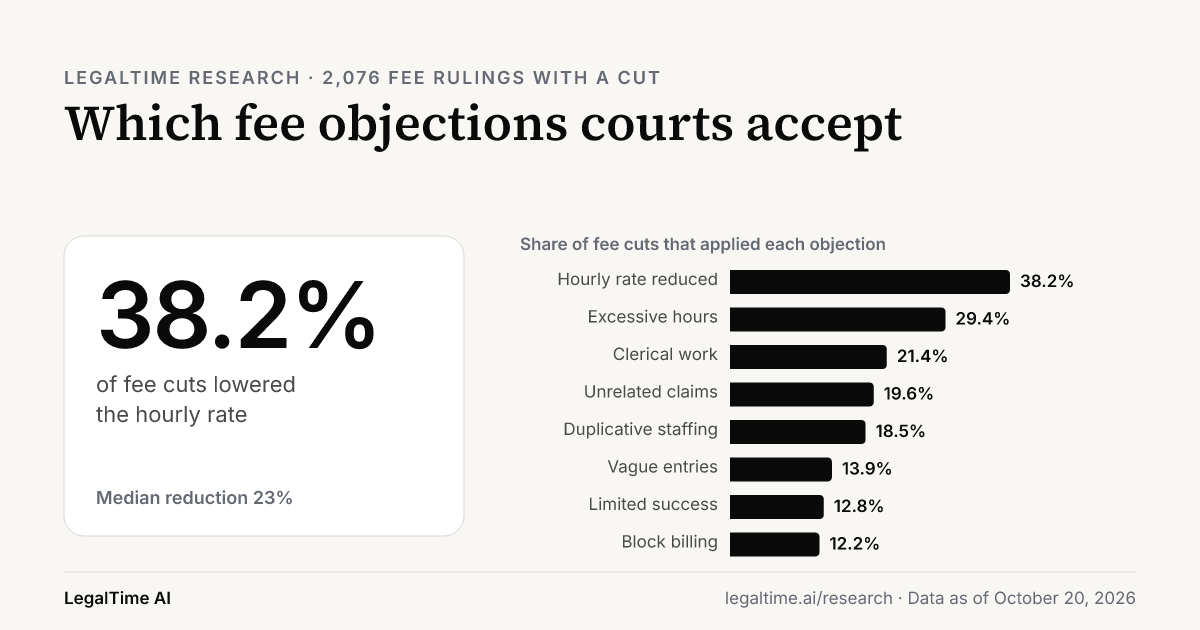
Objections to the rate, then to excessive hours and clerical work billed as legal work.
| Objection | Share of rulings with a cut | Median reduction stated | Rulings |
|---|---|---|---|
| Hourly rate reduced | 38.2% | 23% | 792 |
| Excessive hours | 29.4% | 25% | 610 |
| Clerical work billed as legal work | 21.4% | 25% | 445 |
| Unrelated claims | 19.6% | 36.7% | 406 |
| Duplicative staffing | 18.5% | 25% | 385 |
| Vague entries | 13.9% | 25% | 288 |
| Limited success | 12.8% | 35% | 266 |
| Block billing | 12.2% | 20% | 254 |
| Fees on fees | 7.7% | 30% | 159 |
| Travel time | 4.7% | 50% | 98 |
| Missing contemporaneous records | 2.9% | 25% | 60 |
| Reconstructed time | 1.3% | 26 |
Share of rulings since January 2024 that cut a fee and applied that reduction. The median is of the percentages courts stated.
Which objections cut the most?
Objections to limited success (median 30% of the whole fee or all hours), time on the fee motion itself (median 30% of the whole fee or all hours) and excessive hours (median 25% of the whole fee or all hours).
The most frequent objections are not always the ones that take the most off. These medians count only reductions applied to the whole fee or to all hours; a cut to just the affected entries (for example, paying travel time at half rate) is smaller than its percentage suggests.
What courts said
the Court finds it reasonable to approve an hourly rate of $650 – the top end of the range of rates commonly awarded to lemon law attorneys in this district – for Mr. Shahian and Mr. Tabesh (Hourly rate reduced. Marx et al v. FCA US LLC, Oct 16, 2026)
the Court finds that the 42.00 hours expended on this case is excessive for a case involving a default judgment in a copyright infringement case. Therefore, the Court will decrease these hours to 25 hours (Excessive hours. Automotive Lift Institute, Inc. v. Autokato Engineering, LTD, Oct 8, 2026)
some of the tasks conducted by Marissa K. Thomas—specifically, sending certified mail, formatting responses, e-filing, filling out summons, and combining prior invoices—should be excluded because they are administrative (Clerical work billed as legal work. Nichole Sliney Realty Team, Inc. v. Mount Vernon Fire Insurance Company, Oct 16, 2026)
On this record, the Court concludes that the hours spent litigating the remand motion were not reasonably incurred. (Unrelated claims. Marx et al v. FCA US LLC, Oct 16, 2026)
Given the ample staffing by 11 other timekeepers, the Court finds that it was inefficient and unreasonable to add five additional timekeepers who spent less than one hour each on this case. (Duplicative staffing. Marx et al v. FCA US LLC, Oct 16, 2026)
she does not indicate what the nature of that work was and, therefore, the Court will not award attorney's fees for that work or for the additional four hours of work she anticipates (Vague entries. Automotive Lift Institute, Inc. v. Autokato Engineering, LTD, Oct 8, 2026)
How to object effectively
- Object entry by entry where you can. Courts cut most when the objection points to specific entries, then often apply a percentage to the category.
- Attack the rate with district evidence. Prior awards in the same district for lawyers of similar experience are the most persuasive comparison.
- Flag recordkeeping problems: block billing, vague entries and missing or reconstructed records give the court an easy basis for an across-the-board cut.
- Point to limited success and unrelated claims where the result was partial. These produce some of the largest reductions.
For rate comparisons, use court-approved rates by district. For the applicant's side, see what a fee declaration needs.
Methodology and sources
- Every federal ruling on GovInfo since January 2024 that decided the amount of a fee request (3,862 rulings, stipulated awards left out), 2,076 of which cut it.
- Each reduction is counted once per ruling, only where the court's words were found in the opinion.
Limitations. Some federal districts publish few or no opinions to GovInfo, including the Southern District of New York, the Northern District of Illinois, the Middle District of Florida, the Eastern District of Virginia, the Western District of Washington and the District of Nevada. They are missing or thin here. LegalTime sells timekeeping software for law firms. The sections on LegalTime describe our own product; everything else comes from the court rulings.
General information from public court rulings, not legal advice. Data: CSV (CC BY 4.0). Spot an error? Email team@legaltime.ai with the case name and we will correct it.
FAQ
How often do courts reduce a requested fee?
Federal courts cut the requested fee in 53.8% of 3,862 rulings since January 2024 that decided a fee amount.
What is the most successful objection to a fee petition?
Objecting to the rate: courts applied it in 38.2% of rulings with a cut, with a median stated reduction of 23%. Objections to excessive hours came next (29.4%).
Can you object to block billing?
Yes. Courts applied block-billing reductions in 12.2% of rulings with a cut, usually as a percentage of the affected entries or the whole award.
How do you challenge an attorney's hourly rate?
With evidence of what courts in the same district approved for lawyers of similar experience. Prior awards are the most persuasive comparison; see court-approved rates by district.
What is limited success in attorney fees?
A reduction when the applicant won only part of what it sought. Under Hensley v. Eckerhart, 461 U.S. 424 (1983), the court may reduce the award to reflect the results obtained.