Research · How fee awards are calculated
The Lodestar Method: How Federal Courts Calculate Attorney Fees (2026 Data)
In this article
What is the lodestar method?
Reasonable hours times a reasonable hourly rate.
The lodestar is the number of hours reasonably spent on the case multiplied by a reasonable hourly rate. The Supreme Court called it "the most useful starting point for determining the amount of a reasonable fee" in Hensley v. Eckerhart, 461 U.S. 424 (1983), and it is the method federal courts use under nearly every fee-shifting statute.
How do courts calculate it, step by step?
- 1. Set the reasonable hourly rate. The rate is the prevailing market rate in the community where the court sits for similar work by lawyers of similar skill and experience (Blum v. Stenson, 465 U.S. 886 (1984)). The applicant must prove it with evidence beyond its own affidavits: prior awards in the district, declarations from other lawyers, or surveys.
- 2. Count the hours reasonably expended. The court excludes hours that are excessive, redundant, or otherwise unnecessary, and time on unsuccessful claims unrelated to the claims that succeeded. Applicants must submit records detailed enough for the court to check.
- 3. Multiply. Reasonable rate times reasonable hours is the lodestar, which is strongly presumed to be a reasonable fee.
- 4. Adjust only in rare cases. Courts may reduce the lodestar for limited success. Upward enhancements are permitted only in rare and exceptional circumstances (Perdue v. Kenny A., 559 U.S. 542 (2010)).
For the rate, see court-approved hourly rates by district (median partner rate $500).
How often do courts cut the lodestar?
Federal courts cut the requested fee in 53.8% of 3,862 rulings since January 2024 that decided a fee amount.
That is every federal ruling on GovInfo since January 2024 that decided the amount of a fee request, 3,862 rulings in all.
Do courts cut the rate or the hours?
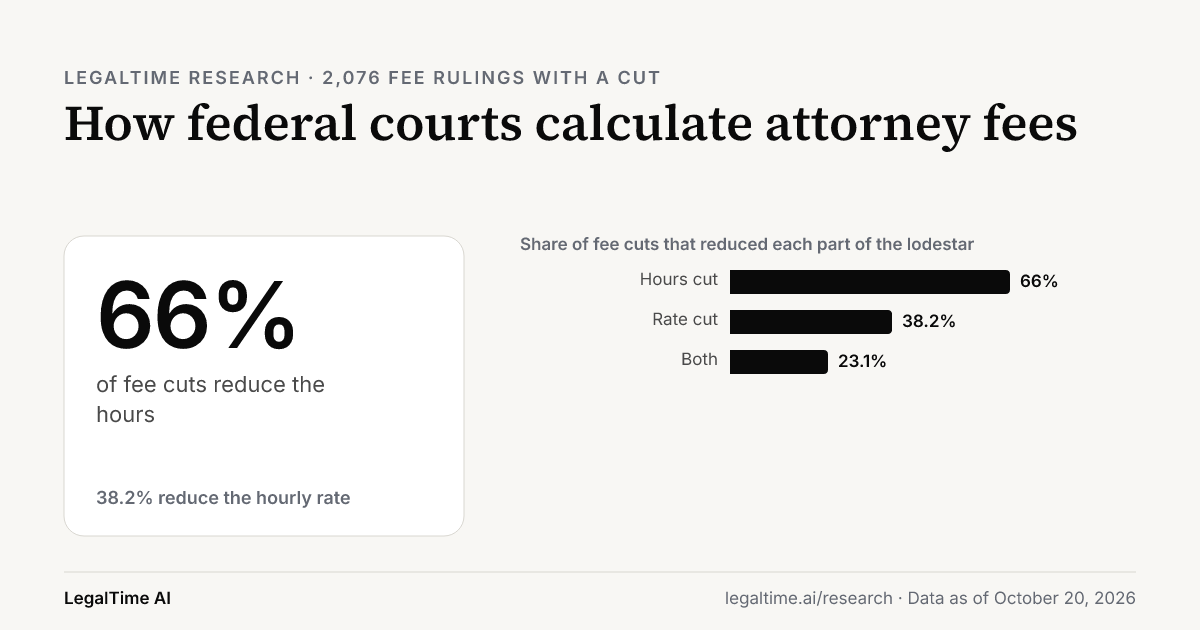
Mostly the hours: 66% of cuts reduced the hours, 38.2% reduced the rate, and 23.1% did both.
| Reduction | Share of rulings with a cut | Median reduction stated |
|---|---|---|
| Hourly rate reduced | 38.2% | 23% |
| Excessive hours | 29.4% | 25% |
| Clerical work billed as legal work | 21.4% | 25% |
| Unrelated claims | 19.6% | 36.7% |
| Duplicative staffing | 18.5% | 25% |
| Vague entries | 13.9% | 25% |
| Limited success | 12.8% | 35% |
| Block billing | 12.2% | 20% |
| Fees on fees | 7.7% | 30% |
| Travel time | 4.7% | 50% |
| Missing contemporaneous records | 2.9% | 25% |
A ruling can apply several reductions. The median is of the percentages courts stated, where they stated one.
How do courts make the cut?
Usually by striking entries, applying a percentage, or both. When courts applied a percentage, the median was 25%.
| Method | Share of cuts |
|---|---|
| Struck or reduced specific entries | 39.5% |
| Both entries and a percentage | 40.5% |
| Percentage of the hours or fee | 20% |
Courts do not have to audit every entry. The Supreme Court has said the goal "is to do rough justice, not to achieve auditing perfection" (Fox v. Vice, 563 U.S. 826 (2011)), which is why so many cuts are across-the-board percentages.
What about lodestar multipliers?
In federal court, upward multipliers are rare.
The lodestar is strongly presumed to be a reasonable fee, and enhancements are allowed only in rare and exceptional circumstances (Perdue v. Kenny A., 559 U.S. 542 (2010)). Downward adjustments for limited success are common: courts applied them in 12.8% of rulings with a cut. Some state courts, such as California's, apply multipliers more often under state law.
To keep the hours side of the lodestar intact, see what a fee declaration needs and fee cuts for bad time records.
Methodology and sources
- Every federal ruling on GovInfo since January 2024 that decided the amount of a fee request, found by a broad search for fee motions, petitions and lodestar language (3,862 rulings, stipulated awards left out).
- Reductions and their stated percentages are taken from the opinion, with the court's words checked against the text.
- Fee multipliers are not yet extracted, so this page does not report how often courts enhance the lodestar.
Limitations. Some federal districts publish few or no opinions to GovInfo, including the Southern District of New York, the Northern District of Illinois, the Middle District of Florida, the Eastern District of Virginia, the Western District of Washington and the District of Nevada. They are missing or thin here. LegalTime sells timekeeping software for law firms. The sections on LegalTime describe our own product; everything else comes from the court rulings.
General information from public court rulings, not legal advice. Data: CSV (CC BY 4.0). Spot an error? Email team@legaltime.ai with the case name and we will correct it.
FAQ
What is the lodestar method of calculating attorney fees?
The lodestar is the number of hours reasonably spent on the case multiplied by a reasonable hourly rate. The Supreme Court called it "the most useful starting point for determining the amount of a reasonable fee" in Hensley v. Eckerhart, 461 U.S. 424 (1983), and it is the method federal courts use under nearly every fee-shifting statute.
How often do courts reduce the lodestar?
Federal courts cut the requested fee in 53.8% of 3,862 rulings since January 2024 that decided a fee amount. When they cut, 66% of rulings reduced the hours and 38.2% reduced the hourly rate.
What is a lodestar multiplier?
An upward or downward adjustment to the lodestar. In federal court the lodestar is strongly presumed reasonable, and upward enhancements are allowed only in rare and exceptional circumstances (Perdue v. Kenny A., 559 U.S. 542 (2010)). Some state courts use multipliers more freely.
What hourly rate goes into the lodestar?
The prevailing market rate where the court sits. Across 31 federal districts, the median court-approved partner rate was $500 an hour.
Does the court have to review every time entry?
Courts do not have to audit every entry. The Supreme Court has said the goal "is to do rough justice, not to achieve auditing perfection" (Fox v. Vice, 563 U.S. 826 (2011)), which is why so many cuts are across-the-board percentages.