Research · 650 federal fee rulings since January 2024
Attorney Fee Cuts for Bad Time Records 2026: Courts Cut 53.8% of Fee Requests
In this article
- How often do courts cut fee requests, and why?
- How much do courts cut fees over time records?
- Which time-record problems do courts cut most?
- How much do courts cut for block billing?
- Vague entries, missing records and clerical work
- Which practice areas see the biggest cuts?
- What were the largest fee cuts?
- How do you keep records that survive a fee petition?
- How does LegalTime help?
- Methodology and sources
- FAQ
How often do courts cut fee requests, and why?
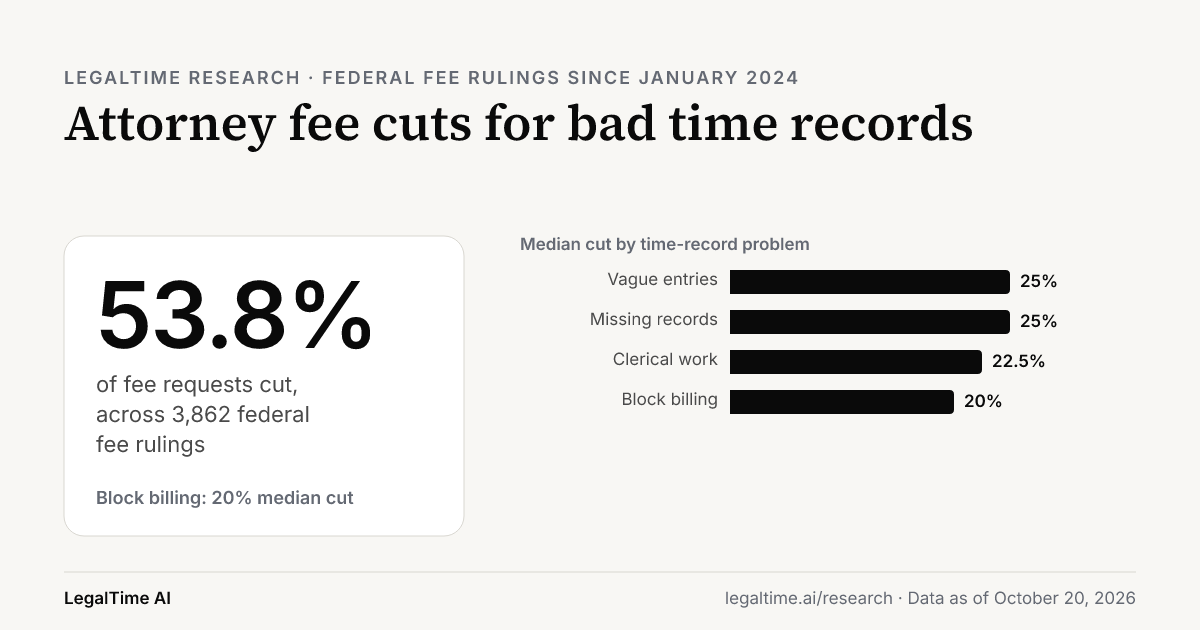
Federal courts cut the requested fee in 53.8% of 3,862 rulings since January 2024 that decided a fee amount.
That is every federal ruling on GovInfo since January 2024 that decided the amount of a fee request, 3,862 in all, not only the ones about time records. Most cuts come from the rate or the amount of work. Problems with the time records themselves (marked below) are a smaller but steady share, and they are the ones a firm controls entirely.
| Reason for the cut | Rulings | Share of rulings with a cut | Time records? |
|---|---|---|---|
| Hourly rate reduced | 792 | 38.2% | |
| Excessive hours | 610 | 29.4% | |
| Clerical work billed as legal work | 445 | 21.4% | Yes |
| Unrelated claims | 406 | 19.6% | |
| Duplicative staffing | 385 | 18.5% | |
| Vague entries | 288 | 13.9% | Yes |
| Limited success | 266 | 12.8% | |
| Block billing | 254 | 12.2% | Yes |
| Fees on fees | 159 | 7.7% | |
| Travel time | 98 | 4.7% | |
| Missing contemporaneous records | 60 | 2.9% | Yes |
| Reconstructed time | 26 | 1.3% | Yes |
| Other reasons | 708 | 34.1% |
A ruling can cut for several reasons, so shares add up to more than 100%. "Other reasons" covers reductions outside these categories, such as unidentified timekeepers or arithmetic errors in the bills.
Hourly rate reduced
The most common way federal courts cut a fee request is lowering the hourly rate, in 38.2% of 2,076 rulings with a cut since January 2024.
How much do courts cut fees over time records?
In 558 federal rulings that cut a fee award at least partly over time records since January 2024, courts awarded a median 26.8% less than the fee requested.
The tracker lists every federal ruling we found, since January 2024, in which the court cut a fee award at least partly because of the time records. The figure covers the whole reduction in each ruling, which often also includes rate cuts or hours the court found excessive.
26.8%
In 558 federal rulings that cut a fee award at least partly over time records since January 2024, courts awarded a median 26.8% less than the fee requested.
$70,224,576
Federal courts cut $70,224,576 from fee requests in 558 rulings since January 2024 that cited problems with the time records among their reasons.
Which time-record problems do courts cut most?
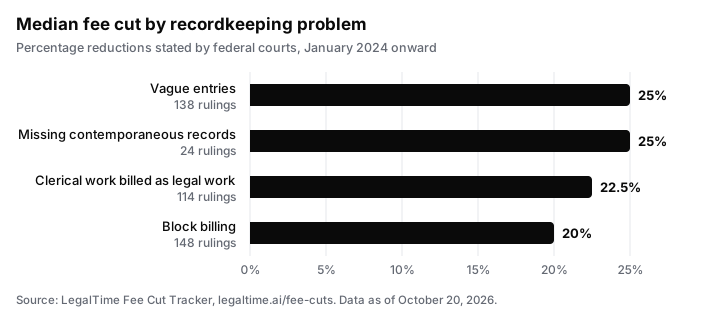
Clerical work billed as legal work is the most common recordkeeping problem behind fee cuts, cited in 58.3% of 650 federal rulings since January 2024.
| Problem | Median cut | Rulings with a stated % | Share of rulings |
|---|---|---|---|
| Vague entries | 25% | 138 | 38% |
| Missing contemporaneous records | 25% | 24 | 7.2% |
| Clerical work billed as legal work | 22.5% | 114 | 58.3% |
| Block billing | 20% | 148 | 33.1% |
Embed
As an image (updates weekly):
<a href="https://www.legaltime.ai/research/attorney-fee-cuts-bad-time-records"><img src="https://www.legaltime.ai/fee-cuts/charts/median-cut-by-reason.svg" alt="Median fee cut by recordkeeping problem. Source: LegalTime Fee Cut Tracker" width="720" style="max-width:100%;height:auto"></a>Or as a frame:
<iframe src="https://www.legaltime.ai/fee-cuts/embed/chart/median-cut-by-reason" title="Median fee cut by recordkeeping problem" width="100%" height="460" style="border:0;max-width:720px" loading="lazy"></iframe>
<p style="font:13px/1.4 system-ui,sans-serif;margin:6px 0 0">Data: <a href="https://www.legaltime.ai/research/attorney-fee-cuts-bad-time-records">LegalTime Fee Cut Tracker</a></p>Show data
| Reason | Median cut | Middle half | Rulings |
|---|---|---|---|
| Vague entries | 25% | 10% to 30% | 138 |
| Missing contemporaneous records | 25% | 18.8% to 33.5% | 24 |
| Clerical work billed as legal work | 22.5% | 10% to 30% | 114 |
| Block billing | 20% | 10% to 30% | 148 |
How much do courts cut for block billing?
When federal courts cut fees for block billing, the median reduction they applied was 20% (148 rulings since January 2024).
Block billing is recording several tasks in one time entry with a single total, such as 3.4 hours to review discovery, call the client, and draft a motion. A court reviewing a fee petition cannot tell how long each task took, so it cannot test whether the time was reasonable. The usual response is a percentage cut to the block-billed entries or to the whole award.
The Court finds that Dr. Huang's calculation represents a reasonable lodestar amount. It will impose a 10% reduction in fees for unreasonable block billing. (Huang v. University of Texas Arlington, N.D. Texas, Oct 16, 2026)
of the 207.4 hours billed, 108.3 hours, or 52%, were block-billed. Therefore, a 15% global reduction in attorney's fees requests is reasonable and warranted. (Nichole Sliney Realty Team, Inc. v. Mount Vernon Fire Insurance Company, D. Massachusetts, Oct 16, 2026)
Vague entries, missing records and clerical work
When federal courts cut fees for vague entries, the median reduction they applied was 25% (138 rulings since January 2024).
When federal courts cut fees for missing contemporaneous records, the median reduction they applied was 25% (24 rulings since January 2024).
When federal courts cut fees for clerical work billed as legal work, the median reduction they applied was 22.5% (114 rulings since January 2024).
the following entries lack clarity and support, and will therefore be subtracted from counsel’s total hours eligible for attorney fees (Zommick v. Lewis Construction Company LLC et al, D. Arizona)
Which practice areas see the biggest cuts?
Consumer protection (43.4%) and Employment (37.2%) had the largest median cuts among practice areas with at least 10 rulings.
| Practice area | Rulings | Median cut |
|---|---|---|
| Commercial | 123 | 21.9% |
| Wage and hour | 73 | 23.2% |
| Employment | 44 | 37.2% |
| Social Security | 39 | 22% |
| Civil rights | 39 | 29% |
| Consumer protection | 37 | 43.4% |
| Intellectual property | 33 | 13.5% |
| Bankruptcy | 25 | 35.2% |
| Disability access | 21 | 13.4% |
| ERISA benefits | 17 | 15.7% |
What were the largest fee cuts?
The largest was $3,978,908, in Lawson et al v. Rubin et al (E.D. New York).
| Case | Court | Requested | Awarded | Cut |
|---|---|---|---|---|
| Lawson et al v. Rubin et al | E.D. New York | $8.8M | $4.8M | 45.3% |
| BBK Tobacco & Foods LLP v. Central Coast Agriculture Incorporated | D. Arizona | $5.5M | $2.6M | 53.7% |
| White, et al. v. Sacramento Police Dept., et al. | E.D. California | $2.6M | $230K | 91.1% |
| Klopfenstein et al v. Fifth Third Bank | S.D. Ohio | $5.6M | $3.3M | 41.2% |
| KPM Analytics North America Corporation v. Blue Sun Scientific, LLC et al | D. Massachusetts | $3.8M | $1.5M | 60% |
| Kunze et al v. Baylor Scott & White Health et al | N.D. Texas | $3.1M | $919K | 70.7% |
| Bala v. Oregon Health & Science University et al | D. Oregon | $3.1M | $1.3M | 58.7% |
| ACQIS, LLC v. EMC Corporation | D. Massachusetts | $5.9M | $4M | 31% |
| AECOM Technical Services, Inc. v. Flatiron AECOM, LLC | D. Colorado | $10M | $8.3M | 16.9% |
| Moonbug Entertainment Limited et al v. Babybus (Fujian) Network Technology Co., Ltd | N.D. California | $7.5M | $6M | 20.9% |
Embed
As an image (updates weekly):
<a href="https://www.legaltime.ai/research/attorney-fee-cuts-bad-time-records"><img src="https://www.legaltime.ai/fee-cuts/charts/rulings-by-month.svg" alt="Fee cuts over time records, by month. Source: LegalTime Fee Cut Tracker" width="720" style="max-width:100%;height:auto"></a>Or as a frame:
<iframe src="https://www.legaltime.ai/fee-cuts/embed/chart/rulings-by-month" title="Fee cuts over time records, by month" width="100%" height="460" style="border:0;max-width:720px" loading="lazy"></iframe>
<p style="font:13px/1.4 system-ui,sans-serif;margin:6px 0 0">Data: <a href="https://www.legaltime.ai/research/attorney-fee-cuts-bad-time-records">LegalTime Fee Cut Tracker</a></p>Show data
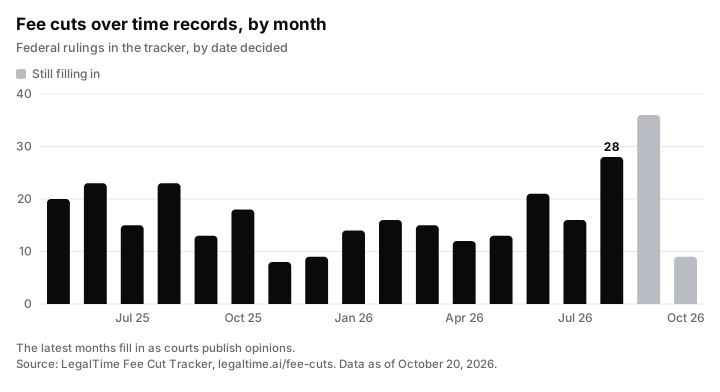
| Month | Rulings |
|---|---|
| 2025-05 | 20 |
| 2025-06 | 23 |
| 2025-07 | 15 |
| 2025-08 | 23 |
| 2025-09 | 13 |
| 2025-10 | 18 |
| 2025-11 | 8 |
| 2025-12 | 9 |
| 2026-01 | 14 |
| 2026-02 | 16 |
| 2026-03 | 15 |
| 2026-04 | 12 |
| 2026-05 | 13 |
| 2026-06 | 21 |
| 2026-07 | 16 |
| 2026-08 | 28 |
| 2026-09 | 36 |
| 2026-10 | 9 |
How do you keep records that survive a fee petition?
Write one entry per task, at the time, saying what was done.
- Record one task per entry, each with its own time, so no entry is block billed.
- Describe what was done and why: the document, the call, the filing. Avoid entries like "attention to file".
- Record time the same day, and keep the original records with their dates.
- Leave purely clerical work off the petition, or bill it as overhead.
How does LegalTime help?
Every problem on this list is a recordkeeping problem, and most come from writing time entries after the fact. LegalTime drafts entries while you work, one per task, timestamped when the work happens and described from the work itself, so the records a fee petition depends on already exist in the form courts ask for.
See the hourly rates federal courts approve
Methodology and sources
- Rulings come from GovInfo, where the federal courts publish their own opinions (district, bankruptcy, and circuit courts), searched every week for fee rulings.
- The tracker covers federal rulings from January 2024 on. A ruling is listed only if the court decided a fee amount and applied at least one reduction for a recordkeeping problem, with the court's words found in the opinion. Stipulated awards are left out.
- Every dollar figure and every quote is checked word for word against the opinion text. The percent cut is computed from the amounts requested and awarded.
- Totals include the whole reduction in each ruling, which can also cover rate cuts, excessive hours, or limited success. The tracker lists rulings with recordkeeping cuts; it does not measure how often courts cut fees overall.
- Case notes are drafted with AI from the checked facts only, then checked again by code before they publish. The court's own words appear as quoted in the opinion.
Limitations. The tracker collects rulings that cut fees over time records; it does not measure how often courts cut fees overall. Some federal districts publish few or no opinions to GovInfo, including the Southern District of New York, the Northern District of Illinois, the Middle District of Florida, the Eastern District of Virginia, the Western District of Washington and the District of Nevada. They are missing or thin here. LegalTime sells timekeeping software for law firms. The sections on LegalTime describe our own product; everything else comes from the court rulings.
Every ruling: Fee Cut Tracker, CSV download (CC BY 4.0). Spot an error? Email team@legaltime.ai with the case name and we will correct it.
FAQ
How often do courts reduce attorney fee requests?
Federal courts cut the requested fee in 53.8% of 3,862 rulings since January 2024 that decided a fee amount. The most common way federal courts cut a fee request is lowering the hourly rate, in 38.2% of 2,076 rulings with a cut since January 2024.
How much do courts cut attorney fees for bad time records?
In 558 federal rulings that cut a fee award at least partly over time records since January 2024, courts awarded a median 26.8% less than the fee requested.
How much do courts reduce fees for block billing?
When federal courts cut fees for block billing, the median reduction they applied was 20% (148 rulings since January 2024). Most courts apply an across-the-board percentage to the block-billed entries or to the whole award, because they cannot tell how long each task took.
What counts as a vague time entry?
An entry that does not tell the court what was done or why, such as "attention to file" or "research". When federal courts cut fees for vague entries, the median reduction they applied was 25% (138 rulings since January 2024).
What is the most common reason courts cut time entries?
Clerical work billed as legal work is the most common recordkeeping problem behind fee cuts, cited in 58.3% of 650 federal rulings since January 2024.
Do courts require contemporaneous time records?
Many do. Courts expect records made at or near the time of the work, and reduce or deny fees for time reconstructed afterwards. When federal courts cut fees for missing contemporaneous records, the median reduction they applied was 25% (24 rulings since January 2024).
How often is this data updated?
Weekly. New federal rulings are collected from GovInfo every Monday, checked against the opinion text, and added here after review.